
Why I wake up in the morning now, not just at morning
My nights used to turn into mornings without me noticing the seam. Not in a fun way.
My nights used to turn into mornings without me noticing the seam.
Not in a fun way. Not late nights with friends that ran long. Just a blur where the night never really ended and the next day never really began. There’s a line in a song that captures exactly what that was like, and the first time it landed on me it stopped me cold because it was describing my whole life back then.
What a broken body clock actually looks like
I kept the blur going on purpose. That’s the part that’s hardest to explain to someone who hasn’t been there. It wasn’t just that sleep was bad or the hours were irregular. I was actively maintaining a state. If I woke up in the middle of the night, there was a bottle of gin under my pillow. Literally under my pillow, so I could take a sip without fully surfacing and go back under.
On weekdays I’d crash when my body forced it or when I had to be somewhere, surface when I had no choice. On weekends there was no schedule at all. I’d pass out from drinking, wake up in the dark not knowing what time it was, and start the second round. Pass out again at whatever hour. Sleep through the morning. Try to piece together a day from what was left of the afternoon.
Sundays were the worst. Stores closed, head pounding, whatever was left in the apartment was whatever I had. I’d drink it and sink back into the fog and wait for Monday, which at least had a structure I had to show up for. Sunday was just me and the blur and no floor under it.
My body had no sense of time. No rhythm. No real rest. I wasn’t living in a day, I was surviving in a state I kept refreshing because stopping felt worse than continuing.
What sobriety actually gave me back
Sobriety gave me mornings back. I mean that almost literally.
Now I wake up in the morning, not just at morning. There’s a difference, and if you’ve lived the other way, you know exactly what it is. At morning means you happen to regain consciousness while the sun is up. In the morning means your body knows what time it is. It knows light means awake. It expects the day before the day arrives.
I wake up at the same time now, every day, and not because I make myself. My body just does it. The rhythm came back. The clock started working again.
Sundays now are the best part of my week. I wake up clear, light coming in, no panic and nothing to suppress. I walk outside. I actually notice the air. I have breakfast because I’m hungry and I know what time it is.
The science that explains why this matters so much
That one detail, getting up at the same time, turns out to matter more than I knew while it was happening.
When researchers look at what predicts whether someone stays sober after treatment, one of the strongest signals isn’t willpower or motivation or how many meetings you attend. It’s how regular your sleep and wake times are.
A 2022 study published in Scientific Reports tracked people leaving inpatient alcohol treatment and measured the consistency of their daily sleep patterns. The people who relapsed had significantly more irregular rhythms than those who stayed sober, even after accounting for everything else. The researchers called it the Sleep Regularity Index, and it predicted relapse better than most other factors they measured. (Barb et al., 2022)
A 2025 pilot trial went further. Patients were given a strict daily schedule alongside standard care — fixed times for waking, eating, moving, getting light, sleeping. Six weeks later, only 2 of 17 in the structured group had relapsed, with 3 drinking days total. In the control group, 10 of 16 had relapsed, with 52 drinking days. The people who slipped in the structured group tended to do it right after their schedule came loose. The wake time drifted. The routine went slack. The drink came after that, not before. (Springer et al., 2025)
So the most boring fact about my day is also one of the most protective things I do. Alcohol dismantles the body clock that runs your sleep, your mood, your hormones. Steady wake times and morning light are how you rebuild it.
How Auven fits in
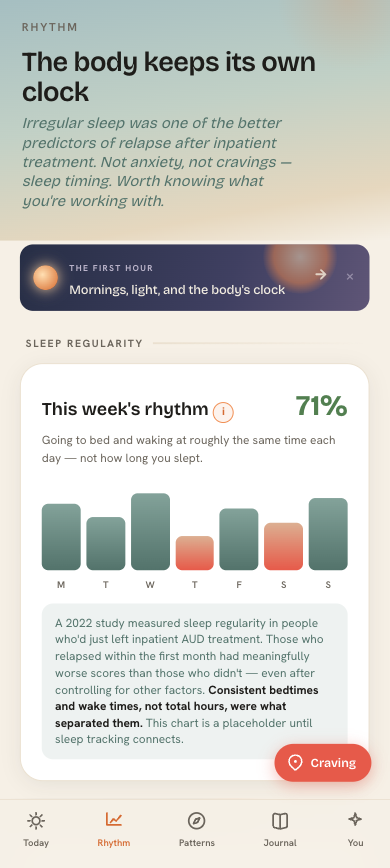
In early sobriety your body clock is still relearning itself. You can’t always feel whether your rhythm is coming back or drifting. That’s part of what Auven tracks — not as a surveillance tool, not to give you a score, but because having a simple external anchor while the internal one is still finding its feet actually helps. A logged wake time. A morning check-in. A visible rhythm you can see taking shape before you can feel it.
The research is clear that a consistent wake time is one of the most protective things in recovery. Auven is built around that, quietly, so you don’t have to think about it.
What it actually feels like
Honestly, I don’t think about any of that most mornings.
What I notice is simpler. The light hits my face at a time my body now expects. I’m awake and clear and it’s actually morning — the real thing, not the wreckage of last night. There’s a quiet moment where I register that I’m here for it.
I’m awake in the morning. And I’m awake for it.
Auven tracks your rhythm quietly in the background — so you can see it coming back before you feel it. Get early access.
Get early access