
When a craving hits, your breath is the fastest way back
I didn't find breathwork in a wellness class. I found it in a moment where I had nothing else left to try.
I want to be upfront about something before I say anything else: I was skeptical of breathwork for a long time. It sounded like the kind of thing people suggested when they had nothing real to offer. Breathe deeply. As if that was going to touch what I was dealing with.
Then I found myself in a moment where everything else had run out, and I tried it anyway, and something shifted that I couldn’t explain and couldn’t ignore.
What my cravings actually felt like
Before I got sober, I’d imagined cravings would be dramatic. An overwhelming physical wave you either survive or you don’t. That’s the version you see in films, the one people describe in meetings.
Mine weren’t like that. Mine were quieter and, in some ways, harder to fight.
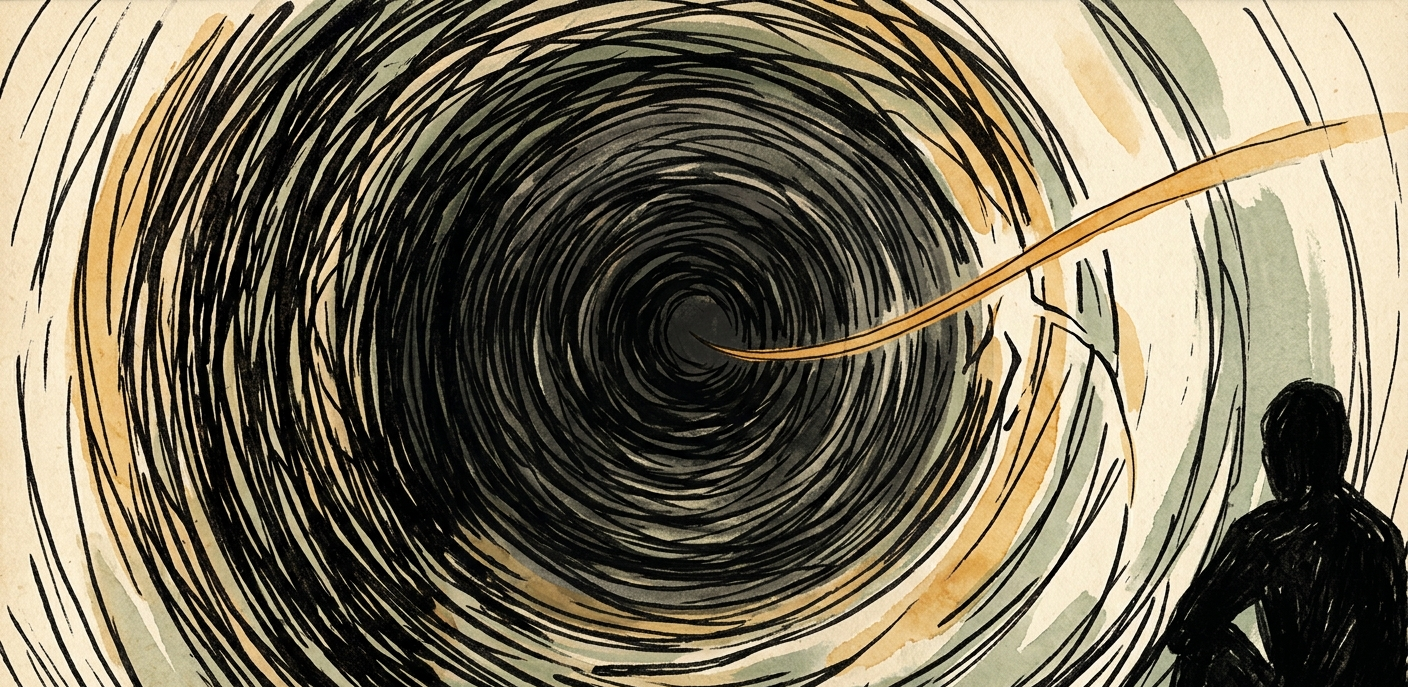
For me, a craving was a thought that moved in and refused to leave. Not violent. Just constant. It would start somewhere in the background as a small, insistent idea, and then slowly crowd out everything else until it was the only thing in my head. Fully occupying. Not a wave — more like a frequency that kept getting louder until I couldn’t hear anything else over it.
And I mean everything else.
I need to say this clearly because I think it’s important and because I’ve never heard anyone describe it quite this way: when I hadn’t had a drink for long enough and that thought took hold, nothing else existed. Not really. Not in any way that moved me to act. I could be in a room with my daughter — my daughter who I love more than anything — and if she was sick, if she needed something, if she was crying, the craving would still be louder. I would still be somewhere else in my head, just waiting until I could get to the drink, and only then would I come back. Only then would I be able to care the way a parent is supposed to care.
That’s the most terrible thing I’ve ever written down. It’s also completely true, and I think people in the grip of it need to hear that it happens, because the shame of it keeps you silent, and the silence keeps you stuck.
The craving didn’t just take over my thoughts. At its worst, it temporarily took over my entire sense of what mattered. Everything and everyone else became background noise until the loop was fed. That’s not weakness. That’s what a nervous system in full alarm state, running on a years-long program, actually does.
I also want to say: cravings look different for everyone. Some people experience them as something physical — a tightening, a restlessness, something that comes in waves through the body. Both are real. Both are brutal in their own way. What I’m describing is mine. If yours look different, that doesn’t make them easier or harder. It just makes them yours.
Why arguing with it never worked
The worst part of the obsessive-thought version is that engaging with it makes it worse.
Every time I tried to reason my way out of it — to remind myself why I shouldn’t drink, to run through the consequences, to talk myself down — I was essentially having a conversation with the craving. Which meant I was still thinking about it. Which meant it was still filling the room. Logic was useless because the craving wasn’t logical. It was a state. And you can’t argue your way out of a state.
I needed something that could interrupt the loop rather than feed it. Something that didn’t require engaging with the thought at all.
What I found
Somewhere in the middle of early sobriety, on one of those stretched-out afternoons where the thought had been sitting in my head for hours, I started breathing differently. Slowly. Deliberately. Longer out than in.
I didn’t know what I was doing. I just knew I was exhausted from the noise of it, and this gave me something else to do — something that required just enough attention that the loop had to compete with it.
I counted the exhale out longer than the inhale. Did it again. And again. And after a few minutes something quieted that hadn’t been quiet in hours. The thought was still there, but it had lost its grip. It had gone from filling the entire room to something I could see from across the room.
I thought it was a coincidence the first time. The second time I noticed it, I started paying attention. Slowing the breath down was doing something that reasoning couldn’t do. It wasn’t arguing with the craving. It was changing the conditions the craving needed to stay loud.
Why it actually works
The obsessive, looping quality of a craving isn’t a character flaw or a lack of willpower. It’s what happens when the nervous system is running a chronic alarm program.
Alcohol, over years of heavy use, suppresses the parasympathetic system — the part responsible for calm, for the felt sense that things are okay — and leaves the sympathetic system, the fight-or-flight machinery, running too hot. In recovery, that imbalance doesn’t fix itself overnight. The brain is still braced, still scanning for threat, still running the old emergency programs. A craving, in that context, is the nervous system doing what nervous systems do under stress: latching onto the thing that used to make the alarm stop, and refusing to let go until it gets it.
The vagus nerve is the main pathway of the parasympathetic system — the one that signals to the body that it’s safe to stand down. Slow, deliberate breathing, specifically where the exhale is longer than the inhale and the pace drops to around six breaths per minute, directly activates the vagus nerve. Each long exhale is a message to the nervous system: we’re okay. The loop can stop now.
Research confirms this changes more than just how you feel in the moment. An 8-week study of people in addiction recovery found that those who practiced slow breathing to raise their heart-rate variability — a measure of how well the parasympathetic system is functioning — were 64% less likely to drink on any given day compared to a control group. Their cravings dropped significantly. Their negative mood dropped significantly. The breathing wasn’t helping them think differently about alcohol. It was changing the underlying state that made the thought feel so urgent and so consuming. (Burg et al., HRV biofeedback RCT)
A separate trial found that people who used slow resonance breathing whenever urges arose kept their cravings completely flat across eight weeks — while the control group’s escalated steadily. The breathing didn’t remove the triggers. It interrupted the chain between trigger and fixation before the fixation could take hold. (Outpatient SUD trial, slow breathing vs. control)
That’s what I’d stumbled into on that long afternoon. Not a coping strategy in the vague, soft sense. Something that was reaching into the actual mechanism — the alarm state underneath the loop — and turning the volume down before I could get lost in the noise of it.
What it looked like for me — and what it might look like for you
I’m not going to give you a breathing exercise with numbered steps. That’s not what this is.
What I can tell you is what worked for me. I’d notice the thought starting to take over — that quality of it crowding everything out, getting louder, starting to feel like the only thing in the room. I’d stop whatever I was doing, sit down if I could, and breathe out for longer than I breathed in. Slowly. Not dramatically. Just longer and slower than whatever I’d been doing, which in a craving state was usually fast, shallow, and completely unconscious.
I’d do it until the grip loosened. Usually a few minutes. The thought didn’t always disappear — but it would change texture. Go from overwhelming to manageable. From something filling every corner of my head to something I could acknowledge without being consumed by it.
It became the first thing I reached for instead of the last. Not because someone told me to. Because it actually worked.
The underlying mechanism — activating the parasympathetic system, lowering the alarm state, interrupting the loop — can be reached through other routes too. Slow breathing is the most direct and the most accessible, because you always have your breath. But some people find the same effect through cold water on the face or wrists, which triggers the same vagal response almost instantly. Others find it through movement — a fast walk, a few minutes of exercise — which burns off the sympathetic activation rather than calming it down. Some find it through music that requires real attention, or through anything that demands enough presence to give the obsessive loop something to compete with. The specific route matters less than the destination: getting the nervous system out of alarm state so the craving loses the conditions it needs to stay in control.
Find the version that works for you. There isn’t a right one.
The thing I’d tell myself from back then
I wasted a lot of afternoons lost inside the loop, trying to out-think something that got louder every time I engaged with it. I thought the answer to a thought was another thought. It isn’t. Sometimes the fastest way out of your own head is through your body.
The breath was always there. I just didn’t know it could interrupt a loop that nothing else could reach.
That’s worth knowing.
Auven is built for the moments between the hard ones — and the hard ones too. Get early access.
Get early access